Jive Talks: XMPP (a.k.a. Jabber) is the future for cloud services
I found this great because it gave me a way to think about something familiar in a different way. I'm use to thinking about XMPP as just an IM and presence protocol, used by applications that let humans to communicate with other humans. But I didn't take it one step further and think of it as a messaging service between machines, mostly because I was under the impression that polling problem was solved (by the likes of Comet).
If this is possible, then by the same token, one should be able to run a "IMsite" over XMPP, analogous to a "web site" over HTTP. It's just that there currently is no "browser" for XMPP. If there were, you can technically send DOM updates or javascript (or whatever the browser can interpret) over XMPP. I imagine one should be able to take the mozilla engine and tack XMPP instead of HTTP in front (probably easier said than done).
That way we should be able to build browser apps that need near-real-time updates. The obvious one is chat. In fact, most of our XMPP clients are specialized to do that. Other applications are collaboration software, like a shared whiteboard (if sending SVG over XMPP would not be a bandwidth hog). Video lectures with auto advancing slides might be another one. Fleet tracking might be another. MMORPGs would also be easier to write on such a platform. It'd be interesting to see where this goes.
Update: Looks like people already tacked XMPP onto Mozilla
Showing posts with label platform. Show all posts
Showing posts with label platform. Show all posts
Thursday, January 24, 2008


Wednesday, November 07, 2007
Nabaztag and pet appliances
A couple weeks ago, I happened upon this strange internet rabbit. Nowadays, there are lots of electronic pets that react to people, so that wasn't anything new. But there were some aspects of Nabaztag that were intriguing and was worth some musing. Nabaztag is a kind of appliance/toy that's connected to the web. It's a little hard to describe at first, but this how it works does a good job of giving examples.
 Generally, I see it as a simplified interface for the web embodied in a pet avatar. If you've ever watched any anime, you'll be familiar with pet sidekicks, usually for comic relief or raising the cuteness factor. If you imagine a sidekick through whom you can channel to communicate/interact with others, or to receive news, that'd probably be on the spot to what a Nabaztag does.
But why do I think it's worth posting?
When the internet was conceived, there were many users on a few computers. This has changed significantly. There are now a few users on many computers. Computers are not only mainframes, but first desktop, then laptops, and now budding, mobile devices. Eventually, there will be many more devices retrofitted for the web, such as refrigerators, stoves, and clocks. But that doesn't mean that there won't be communications appliances made specifically for the web.
Nabaztag seems to be, one of the early steps in making communications appliances in a form that people bond with. This can work one of two ways.
1) Just on the news today was a piece on how toddlers treated a QURIO as one of their own and bonded with it.
I can see something QURIO-like that will do just enough to fool us in the right ways for us to bond with it, like the toddlers have, and make it part of the family--like a home robot. Not really a robot to do heavy labor, but more like a companion/pet that can give you the weather and channels your friends to you.
2) Alternatively, we can have electronic pets that don't fool us, but rather, they are representatives and reflections of ourselves and we use them to interact with our friends' pets (also representatives of themselves). We already do this to some extend through MMORPGs as well as the many Sim Games. However, the difference is that we play those avatars. Here, the pets are recognized to be separate from ourselves, but they are our delegate. Just as people socialize through their dogs at dog parks, I think people will start to socialized based on their physical electronic pets.
If the pets learn its owner's habits, when it meets other people's pets, one might be able to trade information/gossip, or judge how well they'd get along with each other based on how well their pets got along with each other.
So why check the weather through a robot rabbit than through the browser on your computer? Sometimes, it's a lot faster through the rabbit, since it has lights and indicators you can check at a glance. Presumably, that's why the Ambient Orbs have been making money. Information becomes a part of a person's environment, rather than something that's queried.
But an even more compelling reason is that it becomes another dimension in interacting with other humans, and in self-expression. The pet becomes an extension of self that one uses to interact with others. And with the web, the interaction doesn't have to be physical. One of the interesting demonstrations on Nabaztag is that two rabbits can get married, and thus would imitate each other's ears. If a user on one end can control the ears of your friend's pet, you can communicate tactile touch, and your pets would be channeling you to your friend. Extended to a gel-like tactile substance that changes shape like a piezo-electric, it would make it even more real.
And while I don't know for sure whether any of this will happen, it seems like an exciting area to explore.
Saturday, November 03, 2007
Conversion boxes for the old spectrum
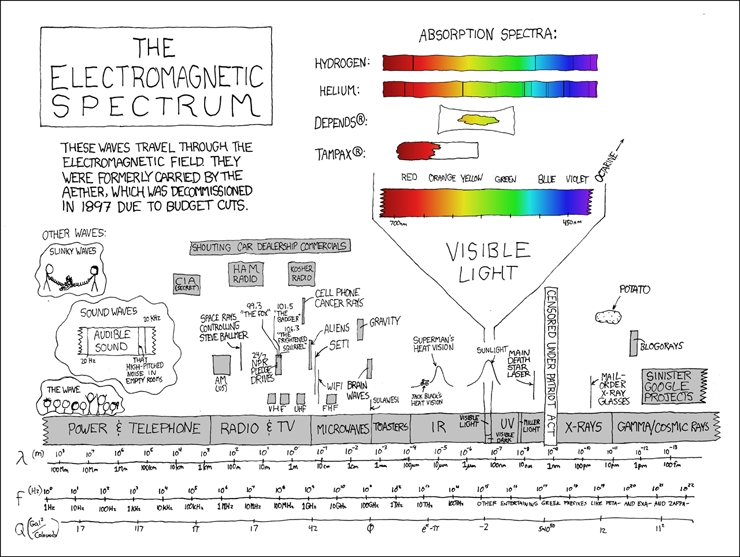
As we all have heard, with the advent of high definition digital TV, old analog TVs aren't going to work anymore. This is because HD digital TV will be broadcast on a different frequency, thus freeing up the old TV frequencies for other uses. The FCC is going to auction this spectrum off to the highest bidder. The likes of Google are bidding on parts of the famed 700MHz spectrum with the intent of providing free wireless internet to the masses. It's considered 'beachfront' property on the wireless spectrum because of its propagation properties. Apparently, 700MHz has a wider coverage area.
But my question is: what to do with all the analog TVs? While more than half of America watches TV through satellite or cable now, there is still a significant portion of people receiving TV signals the old school way. Sure, after the conversion, our old analog TVs can still receive signals, but it won't be able to correctly interpret them. Most people have assumed that if you want to use your old TVs, you'd want to use them to watch TV. Thus, the solution is to buy converter boxes that receive digital TV signals and convert it to the old analog signals.
If we're going to have converter boxes, why not have different types of converter boxes--not only ones to watch TV? As of now, the auction for those bands hasn't happened yet, so we don't know what type of signals are going to be on those channels. But if there's signals that provide free wireless internet, I don't think it's too far fetched to make converter boxes that are thin clients that use the old TV as a monitor. That way, it can not only be a telephone through VOIP, but it can still be television, but an internet television.
Going one step further, the converter box could have a software radio in it, so you can tune to a wide range in the spectrum of radio frequencies, and make use of that signal and the data on that signal if you had the software to interpret it. However, that's not exactly happening soon as today's computational prowess isn't fast enough to digitally process signals at high frequencies. You need to sample the incoming signal at least two times the highest frequency in the signal in order to recover it, and we're just not there yet digitally (at least that's what I read about a year ago).
I hope that people see opportunities here, and take advantage of it, so we can see some innovation in reusing what was once old for the new.
image credit: xkcd.com
Thursday, November 01, 2007
Nerd time - issue 10
Nerd time is just a short mailing list I put out to my ex-coworkers at APL. They're in the applied engineering research fields, so what's going on in the web world isn't well known to them in their daily work, so I fill them in from time to time. If you regularly read techcrunch, proggit, or slashdot, I'm sure you've seen these before.
---
Hey all,
I was going to make this one about new services I use that might not be well known, since there's nothing terribly interesting going on lately. But after a month of haphazardly collecting interesting things, no particular pattern appeared. Just a hodgepodge of things I found interesting. There's nothing terribly hard this time. All easy reading, except for the one on APL at the end.
Take screenshots to measure your productivity.
This is something Ian's been asking for, and I thought he'd like to check it out. No Linux client yet though.
http://www.rescuetime.com
Prof. Randy Pausch's Last Lecture
This is a CMU prof that is dying of cancer, and he gives a last lecture. You can skip all the intros and extros, as the actual lecture is about an hour. It's pretty good, and entertaining. I found his lecture of time management to be pretty helpful.
http://video.google.com/videoplay?docid=-5700431505846055184
Voice tracking camera
This is one of those "simple" things that you wish you did. Theoretically, it's pretty easy. You use microphones to do triangulation, to figure out where the voice is coming from. But when you see his setup, he uses seven all around the room--so it might be a bit complicated. It's a long way from our own two ears.
http://www.youtube.com/watch?v=rrOy6LpL940
Commenting engines
Commenting is one of those fundamental aspects of web interaction that gets implemented over and over again, in wikis, in forums, in social apps, in blogs. But with commenting comes a host of problems. Some technical such as spam bots, cross referencing them, keeping the most relevant ones. Some social, such as trolls, scaling a conversation, etc. These two implement that for you, and commenting becomes just a widget. Not a bad idea, especially if they can thread conversations
across different blogs.
http://cocomment.com
http://www.disqus.com/
Build your own car
I've always wanted a hackable Linux based car. Everything from the onboard entertainment system to the safety system. While this isn't it, it's a step closer. I think they'll ship you all the parts you need to build your own car.
http://www.grabercars.com/content/view/80/2/
Dopplr is a service way to tell your friends, "hey, I'm going to [town], who's already there, let's hang out, or I need a place to crash" sort of thing. It's a social network focused on travelers. I've often was somewhere, and found out a friend was there at the same time too, but we didn't know. It's still in private beta.
http://www.dopplr.com
Mozilla Lab's social network in a browser.
This is an experimental add-on from mozilla that tells you want your friends are doing online. It's like the news feed in facebook. So any time anyone posts a link, updates their status, etc. you'll see it. And sending links to people is easy. You just drag it to their photo in the side bar. So instead of me sending nerd time over email,
I might as well blog it or use something like "The Coop"
http://wiki.mozilla.org/Labs/The_Coop
OAuth is Open Authentication.
I think I posted something about OpenID way back. OpenID is an open way of having uses verify to you they are who they say they are. That way, you don't have to have a separate login/pass everytime you want to use a new service. OAuth is a way for users to grant permission to a new service for their API. So if you signed up for mobtropolis, and your social network is elsewhere, you'd use OAuth to authorize
Mobtropolis to look up your friends.
http://oauth.net/about/
XFN microformats and FOAF
This is also part of the effort to open up your social network. Microformats are basically little bits of meta-data inside HTML tags. It's part of the effort to make the web more semantic. This can be used in conjunction with OAuth to make your social networks portable. We'll see if people make headway. You can view microformats with the Operator mozilla plugin for firefox. Microformats are actually on quite a few web pages now.
http://microformats.org/
http://www.gmpg.org/xfn/
http://www.foaf-project.org/
https://addons.mozilla.org/en-US/firefox/addon/4106
Forth is a stack based programming language. I don't know as much as I should about it, but it's mind-expanding. The language lacked conditional branching and loops. But apparently, that's because you can write your own, not to mention any other weird control structures you can think of. In fact, you can write your own Forth based-PC, its environment, OS, and language in about 2000 lines of code (it is said)
http://weblog.raganwald.com/2007/10/until-you-understand-how-forth-is.html
APL -- the language
I heard of this language, but never managed to see any code. I can see why. You need a whole other keyboard to program in it. But it is pretty neat. You can write Conway's Game of Life in one line. I expect this is because it maps well to functions. Neat idea.
http://catpad.net/michael/apl/
Thursday, August 23, 2007
Review of Facebook app building experience and where things might go
I've been missing in action for a while, because during the first week of August, I finally got around to figuring out how to build a facebook app. I'm involved with a non-profit organization that wished to create an alumni database. I had written a prototype for them the year before in a week, but I never put it up. I didn't get the help or traction that I had hoped for, so I delayed working on it until this past summer, when they had another summer conference.
It's a good thing too, because facebook didn't release their full API until around May. The app is a good fit for what it needed to do, since it allows alumni to find each other. I hacked it out in 4 days, which was both good and bad. I had to bypass a lot of the discipline and good habits I cultivated on my own projects in order to whip it up.
The hardest thing about facebook apps is simply figuring out how the whole thing hangs together. When you don't know the thing is put together, filling out the long form to setup your facebook app, becomes difficult as nothing makes sense.
There are two major parts to a facebook app. One is a profile box, which is the draggable box you see in people's profiles. And the second is the canvas page, which is a kind of "home page" for your app, if you will. You application is hosted somewhere else outside of facebook. The API just lets you create an interface in facebook. It's my recommendation that you read this page on architecture in the facebook wiki before getting started on any of the "Getting Started" pages.
As you can see from the ASCII diagrams in the architecture page, your application's canvas page is called by proxy through facebook servers. That means every time someone visits your canvas page through facebook, facebook will pull your application's canvas page and display it. Conversely, the profile box is data that is pushed to the facebook servers. This makes sense in two faces of the same coin. Facebook has a LOT of users, and chances are, you can't scale as facebook has. Having lots of people bang on your server out the door would wreck havoc on you. Secondly, facebook doesn't want its profile load times to depend on 3rd party servers. If it has all the information pushed to it, facebook can quickly serve profile pages without having to rely on the latency of its 3rd party applications.
I won't go through how to make a facebook app. Plenty of places already do that well, especially this one for Ruby. However, to give my review, I will say that I give it 3 out of 5 stars. "A" for effort, but there's more improvement to be had down the line.
While the API is a step in the right direction, coding for it has felt clunky at best. This is mostly due to documentation being a bit all over the place, but especially the lack of a test environment. There is no way to set a production, test, or development environment for the same application. The only way is to simply create another application as a "test", and point it to your development machine. Then in your code, it has to switch between the development API key and the production API key. In Rails, you'd use the RAILS_ENV global variable to determine which environment you were in. As a result, there's quite a bit of setup to do before you can start hacking away.
Facebook also provides FBML, a reduced HTML, specific for facebook elements. Some of them are quite handy, such as a friend finder, and it gives you an immediate look and feel that blend in with the rest of facebook. However, debugging it isn't much fun at all. Since you can't set environments, facebook assumes all apps are production, and therefore will not show errors and stack traces. Therefore, one has to tread softly, or cut and paste back and forth to their tools.
That's right. Tools. Facebook does provide tools to test out your FBML and API calls. But it would be much nicer if it were integrated in a development environment for the application.
All, in all, it's not been too bad of an experience, outside of wrestling with the setup and FBML, but there's a lot of improvement to be had. While many have said that Facebook is a walled garden like AOL was in the 1990's, I currently don't see much of a decentralized social network solution that addresses privacy that is popular amongst developers.
The only thing that is a remotely good candidate is the combination of OpenID with Microformats like XFN. But I think it's going to take a demonstration from another successful startup to get more developers on this bandwagon. OpenID is also not yet ubiquitous as a concept in the minds of developers, let alone the common web user. Once this happens, it will be much much easier for social applications to personalize a user's experience right out of the box.
And this isn't personalization based on where your stats, but personalization based on what your other friends have done in the very same application. The web app won't know anything about where you live, or where your friends live, but if it's a book store, it will know everything about what books you like, and what books your friends like, and be able to draw conclusions to better serve your experience based on that.
I hope that is an indication of the things to come. Apps will know more about a user's habits as related to their function, and yet not know who this user is to protect privacy. This will be especially useful with mobile devices, since we carry them with us. Any mobile application that knows if you come into contact with your friends in real time will have a tremendous utility value in producing information useful in a social context. We still have to wait, however. The mobile industry is still not as open as we'd like for open development on mobile devices as a platform.
As an aside, I imagine that the reams of data (anonymous, of course) would be a great boon to social scientists. We might see a revolution in that field, especially if it's combined with decentralized computing concepts.
Monday, June 04, 2007
Twittering as a platform
Amazon is posting their deals on twitter. I'm not quite sure that people would want deal ads on their cell phones all the time...
I'm kind of amazed, as are other people in the naysayer category have been, that Twitter had taken off as it has. At its basic form, it's just passing back and forth messages, a problem seemingly solved by email decades ago. However, twitter obvious is not a question of the underlying technology, but rather, how it is presented to and used by people. It's gotten people use to the idea of instant self-expression, no matter how inane--for better or worse. I would have chalked it up for sensors to monitor and log ourselves, but twitter demonstrated that people will report or say anything if there's an audience. Perhaps trolls have already paved the way in this regard.
That said, I think it's easy to write Twitter off as a fad, since the world's largest collection of quips doesn't quite seem to make the world a better place. My guess is that there's probably value in Twitter, but only when it's married with other sorts of data or text processing. Just off the top of my head, geospatial data and emotion detection algorithm on twitter data could generate a heat map of how people are feeling place to place, or time to time. I imagine advertisers would find this information valuable, since they can set up targeted advertising when people are statistically most vulnerable to impulse buying at a certain time or place.
If twitter can manage an API or platform to support this sort of thing, they'll be around for a while, I think. If not, well, at least we'd have the largest collection of quips for the archaeologists of the 22nd century.
Subscribe to:
Posts (Atom)