A short tidbit, no insights: I didn't know that amazon sold analysis of products, like sony ericsson EDGE modem cards...for $100 a page.
I guess IT managers (or whomever makes buying decisions at big companies), have a lot on the line, and they'd be willing to spend the money on this sort of thing. I just wouldn't have thought that it'd be available on Amazon.
Saturday, November 10, 2007


Wednesday, November 07, 2007
Nabaztag and pet appliances
A couple weeks ago, I happened upon this strange internet rabbit. Nowadays, there are lots of electronic pets that react to people, so that wasn't anything new. But there were some aspects of Nabaztag that were intriguing and was worth some musing. Nabaztag is a kind of appliance/toy that's connected to the web. It's a little hard to describe at first, but this how it works does a good job of giving examples.
 Generally, I see it as a simplified interface for the web embodied in a pet avatar. If you've ever watched any anime, you'll be familiar with pet sidekicks, usually for comic relief or raising the cuteness factor. If you imagine a sidekick through whom you can channel to communicate/interact with others, or to receive news, that'd probably be on the spot to what a Nabaztag does.
But why do I think it's worth posting?
When the internet was conceived, there were many users on a few computers. This has changed significantly. There are now a few users on many computers. Computers are not only mainframes, but first desktop, then laptops, and now budding, mobile devices. Eventually, there will be many more devices retrofitted for the web, such as refrigerators, stoves, and clocks. But that doesn't mean that there won't be communications appliances made specifically for the web.
Nabaztag seems to be, one of the early steps in making communications appliances in a form that people bond with. This can work one of two ways.
1) Just on the news today was a piece on how toddlers treated a QURIO as one of their own and bonded with it.
I can see something QURIO-like that will do just enough to fool us in the right ways for us to bond with it, like the toddlers have, and make it part of the family--like a home robot. Not really a robot to do heavy labor, but more like a companion/pet that can give you the weather and channels your friends to you.
2) Alternatively, we can have electronic pets that don't fool us, but rather, they are representatives and reflections of ourselves and we use them to interact with our friends' pets (also representatives of themselves). We already do this to some extend through MMORPGs as well as the many Sim Games. However, the difference is that we play those avatars. Here, the pets are recognized to be separate from ourselves, but they are our delegate. Just as people socialize through their dogs at dog parks, I think people will start to socialized based on their physical electronic pets.
If the pets learn its owner's habits, when it meets other people's pets, one might be able to trade information/gossip, or judge how well they'd get along with each other based on how well their pets got along with each other.
So why check the weather through a robot rabbit than through the browser on your computer? Sometimes, it's a lot faster through the rabbit, since it has lights and indicators you can check at a glance. Presumably, that's why the Ambient Orbs have been making money. Information becomes a part of a person's environment, rather than something that's queried.
But an even more compelling reason is that it becomes another dimension in interacting with other humans, and in self-expression. The pet becomes an extension of self that one uses to interact with others. And with the web, the interaction doesn't have to be physical. One of the interesting demonstrations on Nabaztag is that two rabbits can get married, and thus would imitate each other's ears. If a user on one end can control the ears of your friend's pet, you can communicate tactile touch, and your pets would be channeling you to your friend. Extended to a gel-like tactile substance that changes shape like a piezo-electric, it would make it even more real.
And while I don't know for sure whether any of this will happen, it seems like an exciting area to explore.
Saturday, November 03, 2007
Conversion boxes for the old spectrum
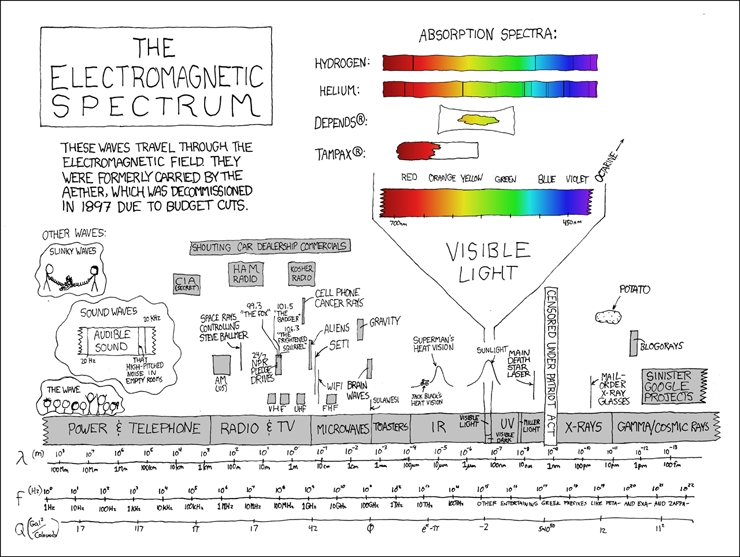
As we all have heard, with the advent of high definition digital TV, old analog TVs aren't going to work anymore. This is because HD digital TV will be broadcast on a different frequency, thus freeing up the old TV frequencies for other uses. The FCC is going to auction this spectrum off to the highest bidder. The likes of Google are bidding on parts of the famed 700MHz spectrum with the intent of providing free wireless internet to the masses. It's considered 'beachfront' property on the wireless spectrum because of its propagation properties. Apparently, 700MHz has a wider coverage area.
But my question is: what to do with all the analog TVs? While more than half of America watches TV through satellite or cable now, there is still a significant portion of people receiving TV signals the old school way. Sure, after the conversion, our old analog TVs can still receive signals, but it won't be able to correctly interpret them. Most people have assumed that if you want to use your old TVs, you'd want to use them to watch TV. Thus, the solution is to buy converter boxes that receive digital TV signals and convert it to the old analog signals.
If we're going to have converter boxes, why not have different types of converter boxes--not only ones to watch TV? As of now, the auction for those bands hasn't happened yet, so we don't know what type of signals are going to be on those channels. But if there's signals that provide free wireless internet, I don't think it's too far fetched to make converter boxes that are thin clients that use the old TV as a monitor. That way, it can not only be a telephone through VOIP, but it can still be television, but an internet television.
Going one step further, the converter box could have a software radio in it, so you can tune to a wide range in the spectrum of radio frequencies, and make use of that signal and the data on that signal if you had the software to interpret it. However, that's not exactly happening soon as today's computational prowess isn't fast enough to digitally process signals at high frequencies. You need to sample the incoming signal at least two times the highest frequency in the signal in order to recover it, and we're just not there yet digitally (at least that's what I read about a year ago).
I hope that people see opportunities here, and take advantage of it, so we can see some innovation in reusing what was once old for the new.
image credit: xkcd.com
Thursday, November 01, 2007
Nerd time 11 - Open social, web on desktop, random tidbits
I use to work at a research lab, and most of them are playing around with other toys outside the web. I send this out as a mailing list just to keep them updated.
---
Google Gphone
Rumor mill's on full churn with speculation about google's gPhone, so even if you read a bit of tech news, you'll probably have heard something about it. I personally don't think that they're looking to compete with apple's iPhone. To me, it makes more sense for them to license an open phone to other phone manufacturers to make it a platform they can do mobile and location-based advertising. We'll see what actually happens.
http://www.techcrunch.com/tag/gphone/
Google Open Social API
Google's going to announce the openSocial API that is suppose to out-open facebook. There are moves here and elsewhere to try and make your social network portable across different web services. That way, if you sign up for a new service, you don't have to tell it who your friends are all over again. The last link is by Marc Andersen of the Netscape Fame. His latest thing is Ning, a tool that lets you build social networks--so obviously, he has a vested interested in the topic.
http://www.techcrunch.com/2007/10/30/details-revealed-google-opensocial-to-be-common-apis-for-building-social-apps/
http://www.techcrunch.com/2007/10/29/googles-response-to-facebook-maka-maka/
http://blog.pmarca.com/2007/10/open-social-a-n.html
Eye-fi
This is something I've been waiting for for about 2 years now. It's an SD card that's also a wifi card. It enables any camera to be wifi-enabled. So you can take pictures and have it be uploaded to the web at the same time. This sort of a thing is a boon to Mobtropolis, as it lowers the barrier between taking a picture and sharing the photo. Hopefully, people will stop taking pictures of the same group pose with all different cameras soon.
http://www.eye.fi/
Mozilla Prism
Prism is still experimental, but both mozilla and adobe are thinking of taking the web experience and putting it back onto the desktop. Prism is mozilla's Thus, every web application will seem like a native application, regardless of whether you're actually connected or not. Thus, you can browse your mail or feed reader even if you're not connected. In addition, desktop apps can take advantage of local hardware acceleration for graphics. This seems similar in concept to Java's Web Start, except it's built on top of web technologies. While nothing's for sure, all the stars seem pointed in this direction. Thus, web developers might start moving on desktop developer's territory in the near future.
http://labs.mozilla.com/2007/10/prism/
How can I use spreadsheets to answer some of my many questions about the world?
One example of mixing the web with traditional desktop applications is that you can actually put queries in your spreadsheet, such as # of users in Paraguay or the ERA of Roger Clemens. Just a tidbit I thought was neat.
http://documents.google.com/support/spreadsheets/bin/answer.py?answer=54199
Evidence Based Scheduling
Joel came out with this article a couple days ago. I thought it was pretty neat and obvious (in hindsight). He comes up with a way to estimate shipping dates of software with a specific probability. He adapts a version of Monte Carlo in order to do it, and while I don't know if it works as well as it claims in practice, I assume that Joel eats his own dog food, and it seems to make sense. If you're interested in software scheduling, defn give it a read.
http://www.joelonsoftware.com/items/2007/10/26.html
The 4 boneheaded biases of voters
As some of you know, I'm pretty interested in decentralized systems--especially since Mobtropolis will have social problems at larger scales if I don't pay attention to them. Capitalist economies and voting systems being two examples. This is an article I found detailing the biases that people have about large-scale decentralized systems--specifically the economy. It's an interesting read.
http://reason.com/news/show/122019.html
State Machine Compiler
Ragel generates state machines for you. I found this to be interesting because I was wondering about how to do minimal aspect orientated programming without a full-fledges AOP system in place.
http://www.cs.queensu.ca/home/thurston/ragel/
Ruby's Object Model
When you grew up with OOP, you think you know it all. But the object model changes when you're using a dynamically typed language. It's a rather different beast altogether, and in order to keep straight the meta-programming things that people do, it helps to know and understand the object model. These are the two best ones that I've seen that explains Ruby's Object Model, and particularly, the Metaclasses.
http://rubyforge.org/docman/view.php/251/96/ChrisPine_UROM.ppt
http://www.klankboomklang.com/2007/10/05/the-metaclass/
MapReduce in a Week
If you've got a week to spare. Mapreduce is how google churns through embarrassingly parallel problems. It has its roots in functional programming. If you don't know what mapreduce it, check out joel below. Though I'm sure I posted that link before, it's worth checking out. He gives a good overview.
http://code.google.com/edu/content/submissions/mapreduce/listing.html
http://www.joelonsoftware.com/items/2006/08/01.html
---
Google Gphone
Rumor mill's on full churn with speculation about google's gPhone, so even if you read a bit of tech news, you'll probably have heard something about it. I personally don't think that they're looking to compete with apple's iPhone. To me, it makes more sense for them to license an open phone to other phone manufacturers to make it a platform they can do mobile and location-based advertising. We'll see what actually happens.
http://www.techcrunch.com/tag
Google Open Social API
Google's going to announce the openSocial API that is suppose to out-open facebook. There are moves here and elsewhere to try and make your social network portable across different web services. That way, if you sign up for a new service, you don't have to tell it who your friends are all over again. The last link is by Marc Andersen of the Netscape Fame. His latest thing is Ning, a tool that lets you build social networks--so obviously, he has a vested interested in the topic.
http://www.techcrunch.com/2007
http://www.techcrunch.com/2007
http://blog.pmarca.com/2007/10
Eye-fi
This is something I've been waiting for for about 2 years now. It's an SD card that's also a wifi card. It enables any camera to be wifi-enabled. So you can take pictures and have it be uploaded to the web at the same time. This sort of a thing is a boon to Mobtropolis, as it lowers the barrier between taking a picture and sharing the photo. Hopefully, people will stop taking pictures of the same group pose with all different cameras soon.
http://www.eye.fi/
Mozilla Prism
Prism is still experimental, but both mozilla and adobe are thinking of taking the web experience and putting it back onto the desktop. Prism is mozilla's Thus, every web application will seem like a native application, regardless of whether you're actually connected or not. Thus, you can browse your mail or feed reader even if you're not connected. In addition, desktop apps can take advantage of local hardware acceleration for graphics. This seems similar in concept to Java's Web Start, except it's built on top of web technologies. While nothing's for sure, all the stars seem pointed in this direction. Thus, web developers might start moving on desktop developer's territory in the near future.
http://labs.mozilla.com/2007
How can I use spreadsheets to answer some of my many questions about the world?
One example of mixing the web with traditional desktop applications is that you can actually put queries in your spreadsheet, such as # of users in Paraguay or the ERA of Roger Clemens. Just a tidbit I thought was neat.
http://documents.google.com
Evidence Based Scheduling
Joel came out with this article a couple days ago. I thought it was pretty neat and obvious (in hindsight). He comes up with a way to estimate shipping dates of software with a specific probability. He adapts a version of Monte Carlo in order to do it, and while I don't know if it works as well as it claims in practice, I assume that Joel eats his own dog food, and it seems to make sense. If you're interested in software scheduling, defn give it a read.
http://www.joelonsoftware.com
The 4 boneheaded biases of voters
As some of you know, I'm pretty interested in decentralized systems--especially since Mobtropolis will have social problems at larger scales if I don't pay attention to them. Capitalist economies and voting systems being two examples. This is an article I found detailing the biases that people have about large-scale decentralized systems--specifically the economy. It's an interesting read.
http://reason.com/news/show
State Machine Compiler
Ragel generates state machines for you. I found this to be interesting because I was wondering about how to do minimal aspect orientated programming without a full-fledges AOP system in place.
http://www.cs.queensu.ca/home
Ruby's Object Model
When you grew up with OOP, you think you know it all. But the object model changes when you're using a dynamically typed language. It's a rather different beast altogether, and in order to keep straight the meta-programming things that people do, it helps to know and understand the object model. These are the two best ones that I've seen that explains Ruby's Object Model, and particularly, the Metaclasses.
http://rubyforge.org/docman
http://www.klankboomklang.com
MapReduce in a Week
If you've got a week to spare. Mapreduce is how google churns through embarrassingly parallel problems. It has its roots in functional programming. If you don't know what mapreduce it, check out joel below. Though I'm sure I posted that link before, it's worth checking out. He gives a good overview.
http://code.google.com/edu
http://www.joelonsoftware.com
Nerd time - issue 10
Nerd time is just a short mailing list I put out to my ex-coworkers at APL. They're in the applied engineering research fields, so what's going on in the web world isn't well known to them in their daily work, so I fill them in from time to time. If you regularly read techcrunch, proggit, or slashdot, I'm sure you've seen these before.
---
Hey all,
I was going to make this one about new services I use that might not be well known, since there's nothing terribly interesting going on lately. But after a month of haphazardly collecting interesting things, no particular pattern appeared. Just a hodgepodge of things I found interesting. There's nothing terribly hard this time. All easy reading, except for the one on APL at the end.
Take screenshots to measure your productivity.
This is something Ian's been asking for, and I thought he'd like to check it out. No Linux client yet though.
http://www.rescuetime.com
Prof. Randy Pausch's Last Lecture
This is a CMU prof that is dying of cancer, and he gives a last lecture. You can skip all the intros and extros, as the actual lecture is about an hour. It's pretty good, and entertaining. I found his lecture of time management to be pretty helpful.
http://video.google.com/videoplay?docid=-5700431505846055184
Voice tracking camera
This is one of those "simple" things that you wish you did. Theoretically, it's pretty easy. You use microphones to do triangulation, to figure out where the voice is coming from. But when you see his setup, he uses seven all around the room--so it might be a bit complicated. It's a long way from our own two ears.
http://www.youtube.com/watch?v=rrOy6LpL940
Commenting engines
Commenting is one of those fundamental aspects of web interaction that gets implemented over and over again, in wikis, in forums, in social apps, in blogs. But with commenting comes a host of problems. Some technical such as spam bots, cross referencing them, keeping the most relevant ones. Some social, such as trolls, scaling a conversation, etc. These two implement that for you, and commenting becomes just a widget. Not a bad idea, especially if they can thread conversations
across different blogs.
http://cocomment.com
http://www.disqus.com/
Build your own car
I've always wanted a hackable Linux based car. Everything from the onboard entertainment system to the safety system. While this isn't it, it's a step closer. I think they'll ship you all the parts you need to build your own car.
http://www.grabercars.com/content/view/80/2/
Dopplr is a service way to tell your friends, "hey, I'm going to [town], who's already there, let's hang out, or I need a place to crash" sort of thing. It's a social network focused on travelers. I've often was somewhere, and found out a friend was there at the same time too, but we didn't know. It's still in private beta.
http://www.dopplr.com
Mozilla Lab's social network in a browser.
This is an experimental add-on from mozilla that tells you want your friends are doing online. It's like the news feed in facebook. So any time anyone posts a link, updates their status, etc. you'll see it. And sending links to people is easy. You just drag it to their photo in the side bar. So instead of me sending nerd time over email,
I might as well blog it or use something like "The Coop"
http://wiki.mozilla.org/Labs/The_Coop
OAuth is Open Authentication.
I think I posted something about OpenID way back. OpenID is an open way of having uses verify to you they are who they say they are. That way, you don't have to have a separate login/pass everytime you want to use a new service. OAuth is a way for users to grant permission to a new service for their API. So if you signed up for mobtropolis, and your social network is elsewhere, you'd use OAuth to authorize
Mobtropolis to look up your friends.
http://oauth.net/about/
XFN microformats and FOAF
This is also part of the effort to open up your social network. Microformats are basically little bits of meta-data inside HTML tags. It's part of the effort to make the web more semantic. This can be used in conjunction with OAuth to make your social networks portable. We'll see if people make headway. You can view microformats with the Operator mozilla plugin for firefox. Microformats are actually on quite a few web pages now.
http://microformats.org/
http://www.gmpg.org/xfn/
http://www.foaf-project.org/
https://addons.mozilla.org/en-US/firefox/addon/4106
Forth is a stack based programming language. I don't know as much as I should about it, but it's mind-expanding. The language lacked conditional branching and loops. But apparently, that's because you can write your own, not to mention any other weird control structures you can think of. In fact, you can write your own Forth based-PC, its environment, OS, and language in about 2000 lines of code (it is said)
http://weblog.raganwald.com/2007/10/until-you-understand-how-forth-is.html
APL -- the language
I heard of this language, but never managed to see any code. I can see why. You need a whole other keyboard to program in it. But it is pretty neat. You can write Conway's Game of Life in one line. I expect this is because it maps well to functions. Neat idea.
http://catpad.net/michael/apl/
Friday, October 26, 2007
ArbCamp 2007
Well, I'm headed out to ArbCamp 2007. It's my first conference in a long while, and a first "unconference". I think I've been stuck with my nose to the grindstone the last couple of months, so it'll be nice to see what other people are doing. If any of you happen to be out in Ann Arbor or doing to ArbCamp, drop me a line, and we can meet up.
There should be some more exciting things to post after this weekend, from ArbCamp and otherwise. Til Monday.
There should be some more exciting things to post after this weekend, from ArbCamp and otherwise. Til Monday.
Monday, October 22, 2007
Where do you put the rules of Monopoly?
It's apparently a favorite interview question. I have to admit, the first response in my head wasn't a great one, which was "everywhere".
What are game rules? When browsing the rules of popular games like Monopoly and Scrabble, they seem to follow a similar format:
Logging is often cited as the poster-child problem to solve with AOP. Logging needs to be done everywhere in the code, but it really has nothing to do with the responsibilities of the class that it's performed in. So you have the same code doing the same thing, duplicated everywhere because there's no one place to put it to make things easy to change.
By the same token, game rules and scoring are of the same nature. And because game rules involve lots of different objects at once, and scoring is interspersed throughout, I think that makes it a good candidate for AOP. However, Ruby has no such direct support for AOP. Instead, the closest thing we have are observers, before/after/around filters (in Rails), and some meta-programming.
I wanted something that allowed me to list out rules like games like Monopoly and Scrabble. I'd have a setup, and some conditions and their effects. Scoring is simplified here because the only time you can score is when one of the models is created or changes state. This is a good fit to the observers and the filters available in Rails.
I thought it was an interesting way about it and probably warranted some criticism. Is there any particular disadvantage of doing it this way? And if you can think of a way to not have to explicitly state the model relationships in the setup, that'd be nice. half-tip!
What are game rules? When browsing the rules of popular games like Monopoly and Scrabble, they seem to follow a similar format:
- The initial conditions of the game (the setup)
- Then given a condition,
- the set of allowable actions for the player to do
- the effects of the condition
class SceneRulesThen I'd be able to call it from the controllers. However, on second thought, it's rather ugly, since I'd be updating the karma everywhere in the controllers. If I understand cross-cutting concerns correctly, scoring karma would be a good example of one. I suppose it's a good candidate for aspect orientated programming, so I scrapped the code above.
def initialize(model)
@scene = model
@user = @scene.submitting_user
end
def on_submit
@user.points += 1
end
end
class SceneshotRules
def initialize(model)
@sceneshot = model
@user = @sceneshot.sceneshot_uploader
end
def on_submit
@user.points += 10
@scene.submitting_user.points += 5
end
end
Logging is often cited as the poster-child problem to solve with AOP. Logging needs to be done everywhere in the code, but it really has nothing to do with the responsibilities of the class that it's performed in. So you have the same code doing the same thing, duplicated everywhere because there's no one place to put it to make things easy to change.
By the same token, game rules and scoring are of the same nature. And because game rules involve lots of different objects at once, and scoring is interspersed throughout, I think that makes it a good candidate for AOP. However, Ruby has no such direct support for AOP. Instead, the closest thing we have are observers, before/after/around filters (in Rails), and some meta-programming.
I wanted something that allowed me to list out rules like games like Monopoly and Scrabble. I'd have a setup, and some conditions and their effects. Scoring is simplified here because the only time you can score is when one of the models is created or changes state. This is a good fit to the observers and the filters available in Rails.
class ScoringRules < ActiveRecord::ObserverHere, the Rules module is what encapsulates the setup, rule, and rule_dispatch calls. I needed setup so that I can access different "game elements" (the board and the players) to update the scoring. It basically stores the setup as a list of lambdas that it can execute at a later time when the rule needs to be executed. Now, when a model is created, we ask the rule dispatcher to figure out which rules execute based on the rules we've named, and then execute the attached block. The block is passed a hash of different game pieces that it needs to update the score and the game conditions. That's it.
observe Sceneshot, Scene
include Rules
setup { :scene => Proc.new { |sceneshot| sceneshot.scene } },
{ :sceneshot_uploader => Proc.new { |sceneshot| sceneshot.sceneshot_uploader },
:scene_submitting_user => Proc.new { |sceneshot| sceneshot.scene.submitting_user } }
rule :after_create_sceneshot do |board, players|
players[:scene_submitting_user].score += 5
end
# put more rules here
def after_create(model)
rule_dispatch(:after_create, model)
end
end
I thought it was an interesting way about it and probably warranted some criticism. Is there any particular disadvantage of doing it this way? And if you can think of a way to not have to explicitly state the model relationships in the setup, that'd be nice. half-tip!
Thursday, October 11, 2007
Operator for Microformats
I've put microformats in the stuff I've built before. And to be honest, I wasn't sure if they were going to take off. The formats were there, but none of the tools to actually use them were around. For a long time, I just used the tails export add-on in firefox. You couldn't really do anything with it, but you could at least see microformats.
The Operator takes it one step further, and adds actions to microformats. In a way, it's a god-send, and now I'm wondering why I didn't write it. I HATE having to cut and paste addresses into google maps. Now, if there's a microformat of an address on a page now, all I have to do is use Operator--two clicks and I'm there. (As an aside, Humanized Enzo makes it even easier to include maps.)
Microformats have been gaining momentum for a year now, and I think it will be important in the web to come. Not because it's one-more-thing to have to know, but because the guys over at social network portability are using it as part of their solution to open up the walled gardens of the social network stovepipes in effect today.
Given how we're all use to using web applications today, it's as if we're always 'reborn' every time we sign up for a new service. It's an odd idea to be able to "take your network with you". If you can do this, especially as mobile devices get more powerful, there can be more and more web applications that can act as mediators in social contexts of the users as they go about the world.
One nice little app would be a name-recaller. At a conference or a party, my mobile phone would detect which other mobile phones are around. It could then query the web application whether I've met any of these people before, and what their names are. So when I actually go to shake their hand, I can address them by name. And as we all know, the sweetest sound to a person's ears is his/her own name.
But that's still a long ways from now. Probably not in another 4 or 5 years, if not more. However, I'd keep an eye on this area. I'm sure you'd hear more about it soon.
Model Reduction of Complex Dynamics
Model Reduction of Complex Dynamics
Alright, for some actual news. This is something that has been hard to achieve in computer graphics--that is believable fluid mechanics like water or smoke. Traditionally, they've been modeled as really large particle systems, which gets to be pretty expensive computationally.
These guys have managed to reduce the amount of computation required to make these computations to simulate fluids, detailed in this paper.
I've only glanced at the paper, but it looks like they were able to frame the problem in such a way that they were able to use dimension reduction techniques to reduce the number of computations they need to do, but have the least noticeable effect. By noticeable, I mean not only to the eye, but also to physics. It also conserves kinetic energy in the simulation.
I don't understand much of the math in there, as it'll take some time to go through it, but it reminds me of lossy compression algorithms and search engines. Not every piece of information is important, or is important in the same way. If you can frame the problem so that you can throw away less important information and still have approximately the same thing. It's kind of novel to think of it as applied to a computational process, rather than a stream of data.
Tuesday, October 09, 2007
First Review!
Admittedly, I submitted mobtropolis to Geekheartland, but it was nice to get a first review. You'll probably see less and less of these self promotions, since there are only so many "firsts" you can have.
All in all, there was nothing scathing about the review, and it actually said it was interesting. In general, of everyone I've ever talked that got it thought it was "interesting". Honestly, that has me puzzled. From everything I've read and heard about the history of innovation, great and revolutionary ideas polarize people. So far, I haven't really had anyone that got it and was turned off by the idea or thought it could never work. Update: Probably because not enough people have heard about it. I'm sure if the bloggers at Uncov got wind of it, they'd rip it to pieces.
We'll see what happens as I expand on Mobtropolis's vision.
Friday, October 05, 2007
Mergesort in Erlang was to be my redemption--alas it was not
Well, once I got started, I kinda couldn't help myself. I really should be debugging and cleaning up Mobtropolis, but sometimes, you need a break. To add to my shame of Erlang neophytism (probably not even a word), I tried out merge sort.
Ugh. I thought mergesort would be my redemption, since in my mind, it looked shorter. But I ended up having to write split(), since I didn't know the libraries well enough, and couldn't think of a good list comprehension to split the list. Admittingly, it's like deciding to forgo inventing the combustible engine and deciding to start walking--I just built it out what I little I knew. If you're so inclined, you can also try one-liner-ing (also not a word) mergesort, as the bar I set was pretty low. :( Like Bryan says:
Speaking of Bryan, he posted a solution to bubblesort that was pretty good in the last post. It was a good lesson. Like anything worthwhile learning, languages are often easy enough to pick up, but hard to master. This was a good wakeup call to go through the examples in the book and master more Erlang before trying to write anything else on my own.
mergesort([Last]) ->
   [Last];
mergesort(List) ->
   [Left, Right] = split(List, [], []),
   io:format("~w ~w~n", [Left, Right]),
   merge(mergesort(Left), mergesort(Right)).

split([Last], Acc1, Acc2)->
   [ [Last | Acc1], Acc2 ];
split([First | Rest], Acc1, Acc2) when length(Acc1) <>
   split(Rest, [First | Acc1], Acc2);
split([First | Rest], Acc1, Acc2) ->
   split(Rest, Acc1, [First | Acc2]).

merge([], R) ->
   R;
merge(L, []) ->
   L;
merge([L_h | L_t], [R_h | R_t]) when R_h =<>
   [R_h | merge([L_h | L_t], R_t)];
merge([L_h | L_t], [R_h | R_t]) ->
   [L_h | merge(L_t, [R_h | R_t])].
Ugh. I thought mergesort would be my redemption, since in my mind, it looked shorter. But I ended up having to write split(), since I didn't know the libraries well enough, and couldn't think of a good list comprehension to split the list. Admittingly, it's like deciding to forgo inventing the combustible engine and deciding to start walking--I just built it out what I little I knew. If you're so inclined, you can also try one-liner-ing (also not a word) mergesort, as the bar I set was pretty low. :( Like Bryan says:
"Get back into Erlang! it's good for you. ;)"
Speaking of Bryan, he posted a solution to bubblesort that was pretty good in the last post. It was a good lesson. Like anything worthwhile learning, languages are often easy enough to pick up, but hard to master. This was a good wakeup call to go through the examples in the book and master more Erlang before trying to write anything else on my own.
Thursday, October 04, 2007
Bubblesort in Erlang
It's amazing how if a language isn't a part of your daily work, how rusty you get at it. Oh erlang, how I didn't mean to neglect you! I finally convinced Ian to give Erlang a shot, and he's been going through Joe Armstrong's book. He decided to write bubblesort, and it took him hours. This is what he had to say:
Wrong.
It's taken an embarrassingly long time to get it right, plus, I took a shortcut that isn't very optimal. If I ever had to write this in an interview in Erlang, They'd take my keyboard away. Here's what I came up with:
Notice that I use the guard "List =:= New_list" to determine if a swap took place. In a large list, this would add n comparisons on every pass. Horrible. But since it's an exercise, I neglected to keep track of swaps.
More than half the time was wrestling with the syntax. I had forgotten a lot of it, and mixed up [First, Rest] with [First | Rest], and I kept forgetting that I needed to prefix the functions by their module names. It's bubblesort:swap(...) when you want to call it, and I was scratching my head for 10 mins. But the other time was just thinking recursively. Unless you're working in a language the heavily uses recursive to iteration, you don't often use it. But defn I prefer recursive as it's much more succinct. Can anyone come up with a one-liner Bubblesort?
For reference, "the one liner" quicksort Ian was talking about:
I'm having some difficultyI decided to give it a shot. It's certainly a far better exercise than FizzBuzz. Given that I had written a neural network in erlang before, I figured I'd be more than ok with bubblesort. Right?
getting used to the idea of a language where every variable is a const.
its interesting, though.
but I have to admit the one line erlang quicksort is one of the
prettiest code snippits I've ever seen.
but "=:=" for equivalence? a three character long operator? who do
they think they are?
I wrote bubble sort and merge sort in erlang last night. it took
hours. the code looks horrible. for the first time since learning
basic in high school I feel like a foreigner in a strange land. its
invigorating.
actually I find it a bit intimidating. when something takes more than a
few lines of code I wonder if I'm doing it wrong. if joe armstrong ever
saw my bubble sort he'd probably take my book away.
Wrong.
It's taken an embarrassingly long time to get it right, plus, I took a shortcut that isn't very optimal. If I ever had to write this in an interview in Erlang, They'd take my keyboard away. Here's what I came up with:
-module(bubblesort).
-export([sort/1]).

sort([First | Rest]) ->
    sort_helper([First | Rest], swap(First, Rest)).

sort_helper(List, New_list) when List =:= New_list ->
    List;
sort_helper(List, [First | Rest]) ->
    sort_helper([First | Rest], swap(First, Rest)).

swap(Current, []) ->
    [Current];
swap(Current, [First | Rest]) when Current =< First ->
    [Current] ++ swap(First, Rest);
swap(Current, [First | Rest]) ->
    [First] ++ swap(Current, Rest).
Notice that I use the guard "List =:= New_list" to determine if a swap took place. In a large list, this would add n comparisons on every pass. Horrible. But since it's an exercise, I neglected to keep track of swaps.
More than half the time was wrestling with the syntax. I had forgotten a lot of it, and mixed up [First, Rest] with [First | Rest], and I kept forgetting that I needed to prefix the functions by their module names. It's bubblesort:swap(...) when you want to call it, and I was scratching my head for 10 mins. But the other time was just thinking recursively. Unless you're working in a language the heavily uses recursive to iteration, you don't often use it. But defn I prefer recursive as it's much more succinct. Can anyone come up with a one-liner Bubblesort?
For reference, "the one liner" quicksort Ian was talking about:
qsort([]) ->
    [];
qsort([Pivot | T]) ->
    qsort([X || X <- T, X < Pivot]) ++ [Pivot] ++ qsort([X || X <- T, X >= Pivot]).
Wednesday, October 03, 2007
First blog mention!

It's been a little beyond a full month since I kicked Mobtropolis, a social photo scavenger hunt to expand your world, out the door to face some beating out in the real world. Whenever you release something to the public, it's a bit nerve racking. But you always learn something, and better to know early and fix it, than to know later and suffer.
The first major lesson is that people didn't know what they were looking at. I had figured with the advent of Digg and Reddit, that I wouldn't need to explain what Mobtropolis does. How wrong I was. Friends and forum readers would visit, and then leave. I spent the better part of the month refactoring the underbelly of the app, and working on a better and succinct way to communicate the value added for the user. I think this will be a constant struggle, and I'll have to be vigilant about always communicating clearly.
The other thing that I learned is that a lot of things simply don't matter because you're just not at that point yet. For example, I was reluctant on putting in comments since I figured with comments comes trolls, comment spam, etc. But in truth, it's simply not at the point yet. Though I put in some precautions, it was more prudent just to kick something simple out and start using it.
I had the first blog mention today at a spanish tech blog called Genbeta today. That was a nice milestone. While the post was neutral in tone, it did mention that Mobtropolis was:
An interesting collective game in which anyone can participate.
Hopefully, I'll keep getting better. So for those of you out there working on your own stuff, it pays to just get things out there then just iterate. Release early and release often is something you can do with web applications, so take advantage of it. If any of you readers find Mobtropolis useful or interesting, feel free to tell your friends to join you on some wacky adventures.
Saturday, September 29, 2007
Mushkin - Get More
Mushkin - Get More
If you follow my blog, it's really not often that I give plugs for products or services. But sometimes, when your experience is just overwhelming positive, you just have to give credit where credit is due.
Three years ago, I brought a Dell Dimension 2400. It's a 2.66GHz P4 computer--paltry by even by yesterday's standards, but it was cheap...about $500. I brought it on a whim, and since then, it's become my main development machine. However, I had only brought it with 512MBs of RAM...which I thought was more than enough at the time.
Enter Firefox 2 stage left. The elephant that easily eats up 230MBs.
Like I lamented before, I've been having productivity slow-downs due to applications using an extraordinary amount of memory. I was actually watching screens redraw itself because the swap partition was being exercised like crazy. I had sworn off Eclipse because I felt that for what I used it for, it was eating up too much memory. But at the end of the day, what room was left by Eclipse was taken up by Firefox 2.
In the end, I succumbed and went out to buy more RAM for my machine while waiting for Firefox 3. But it's been so long (2 years) since I brought hardware, I didn't know what to get. Kudos to Dell for providing easy ways to look up what RAM you need by its model number. I use to revel in being able to look up specs to find the lowest price, but I simply don't have the time anymore. Dell was offering 1GB RAM for $109. Seemed reasonable. But I decided to check Mushkin.
I've used Mushkin since my sophomore year in college (8 years ago!), and none of the RAM I've ever purchased from them have ever failed so far. Believe me, RAM fails. Probably not as fast as hard drives, but RAM fails. And when it does, it's the last thing you assume that has failed. As a result, you waste so much time in your dorm room debugging it instead of out there mixing it up with the co-eds.
I revisited mushkins for the first time in a long time, and I have to say that while they have a dizzying array of RAM from hardcore hardware enthusiasts (what I use to be), they also have easy-to-find components for owners of stock computer models (like for me now). Not only that, they offer the same type of RAM for $30's less. Tres awesome.
Normally, if I just saw Mushkin out of the blue, I don't know if I'd trust them. But having used them all these years, and given that their RAM keeps on ticking, they stand by their quality, however they do it. Not only is their stuff quality, but their shopping experience is a breeze.
So I'd recommend their stuff. If I get Mobtropolis to a point where I need huge servers, I know where I'm getting my RAM.
Ok, next time, will be more coding related stuff, as I have some interesting things to post that have been gathering in the queue. Stay tuned!
Wednesday, September 26, 2007
[115, 117, 109, 109, 97, 114, 105, 122, 97, 116, 105, 111, 110].map{|c| c.chr}.join
Time does fly by when you don't work on the weekend. It's been almost a week since my last post--so you know I've been busy coding. Today, I got stuck on caching, so here I am, blogging.
In Nerd Time 8, I had mentioned the algorithm on content-aware image resizing. For those of you that didn't hear about it a couple weeks ago, watch the movie. It seems pretty magical at first. It basically computes an energy function for the image to decide which part it can cut out if it needed to.
I don't know if the rest of you had the same thought, but content-aware image resizing is essentially image summarization. You're throwing out less important information in the picture in favor of preserving informational features of the image.
They use an energy function as a metric to determine which seams--and in what order--to remove from the picture to reduce its size.
The most surprising thing to me was that the basic energy function is just the magnitude of the gradient function. A gradient function of an image tells you how fast the colors are changing as you're moving across the image. This means the sky would be smooth and slowly varying (low frequency), and the trees would be rough and varies quickly (high frequency). Therefore, the basic gradient energy function just allows you to selectively cut out the low frequency parts of the image while the seam selection preserves the aspect ratio and image coherence.
Apparently, this metric works pretty well, even compared to other metrics like entropy, which is the standard measure of information content. This works mostly because of the assumption that high content areas of the scene will be high frequency, and background images, like sky, road, wall, are generally low frequency images. If you had a picture of me and someone else holding up a flag with a forest as a backdrop, it'll cut out the flag first, not the trees, using the gradient energy function.
This puts text summarization into clearer focus for me. There are two competing goals in text summarization: 1) reduce the amount of text 2) keep the information content high and coherent. With content-aware image resizing, it was able to achieve both goals by finding a metric that was calculable to distinguish between important and non-important. So by comparison, we should be able to do the same with text.
However, we don't know what, if any, the gradient between words means, and how that would fare as a measure of information content. We also don't have a good way of judging coherency of a piece of text--different people will come up with different summaries. In an image, we can look and just tell. This is because we judge all pieces of an image in parallel, and we have a database of images to compare to in our heads to tell if something 'looks right' or not.
One can tell how far apart a color is from another simply by measuring the distance of the hex values that represent that color. However, words that have similar letters may have completely different meanings.
Many people have used co-occurrences of words to map words to meanings, since it makes sense that words related to each other would appear in the same text. However it was found that even if two words had the same meaning, they might have different frequency of occurrences, thus throwing off the validity of the gradient map.
In Nerd Time 8, I had mentioned the algorithm on content-aware image resizing. For those of you that didn't hear about it a couple weeks ago, watch the movie. It seems pretty magical at first. It basically computes an energy function for the image to decide which part it can cut out if it needed to.
I don't know if the rest of you had the same thought, but content-aware image resizing is essentially image summarization. You're throwing out less important information in the picture in favor of preserving informational features of the image.
They use an energy function as a metric to determine which seams--and in what order--to remove from the picture to reduce its size.
The most surprising thing to me was that the basic energy function is just the magnitude of the gradient function. A gradient function of an image tells you how fast the colors are changing as you're moving across the image. This means the sky would be smooth and slowly varying (low frequency), and the trees would be rough and varies quickly (high frequency). Therefore, the basic gradient energy function just allows you to selectively cut out the low frequency parts of the image while the seam selection preserves the aspect ratio and image coherence.
Apparently, this metric works pretty well, even compared to other metrics like entropy, which is the standard measure of information content. This works mostly because of the assumption that high content areas of the scene will be high frequency, and background images, like sky, road, wall, are generally low frequency images. If you had a picture of me and someone else holding up a flag with a forest as a backdrop, it'll cut out the flag first, not the trees, using the gradient energy function.
This puts text summarization into clearer focus for me. There are two competing goals in text summarization: 1) reduce the amount of text 2) keep the information content high and coherent. With content-aware image resizing, it was able to achieve both goals by finding a metric that was calculable to distinguish between important and non-important. So by comparison, we should be able to do the same with text.
However, we don't know what, if any, the gradient between words means, and how that would fare as a measure of information content. We also don't have a good way of judging coherency of a piece of text--different people will come up with different summaries. In an image, we can look and just tell. This is because we judge all pieces of an image in parallel, and we have a database of images to compare to in our heads to tell if something 'looks right' or not.
One can tell how far apart a color is from another simply by measuring the distance of the hex values that represent that color. However, words that have similar letters may have completely different meanings.
The difference between the almost right word & the right word is really a large matter--it's the difference between the lightning bug and the lightning. - Mark TwainI suspect that one would need to use a gradient map for words, or be able to use the etymology of words to measure how far apart the meanings of words are from each other. How to generate this map has been difficult, as far as I know.
Many people have used co-occurrences of words to map words to meanings, since it makes sense that words related to each other would appear in the same text. However it was found that even if two words had the same meaning, they might have different frequency of occurrences, thus throwing off the validity of the gradient map.
Wednesday, September 19, 2007
Diving into Rails source and explaining alias_method_chain in pictures
I've been involved with the local Ruby group, and I did a talk on diving into the Rails source code. I have to admit, I probably should have dove into it earlier, but there was a lot to learn just by using Rails, for someone that was doing engineering work before this. Originally, I was going to just relate my experience of when I had to dive into the code, but then I happened on Rails' Unusual Architecture, and it gave a good topic for introducing metaprogramming used in Rails.
At first, it was pretty confusing, since I came from a C++ background and was use to the idea of design patterns. Well, there are patterns, it's just that in dynamic languages, much of the traditional Gang of Four design patterns goes away.
I'll outline the meat of the talk. Rails doesn't use the Decorator Pattern. Instead it basically renames methods in calls to inject additional functionality that wraps around the original functionality. How does it do this? It uses something called alias_method_chain, detailed here and here.
And inside alias_method_chain, is a native method called alias_method. Since everything in Ruby is an object, and changeable, that means methods of modules and objects are also changeable. It basically makes a copy of the old method and calls it something new.
I made pictures to show the progression. Let's say we have a method called "save" that we want to enhance with "validation".

We start with ActiveRecord and the Validation module. So in our validation module, we make a method called "save_with_validation"(purple heart) that calls a method called "save_without_validation" inside it. "save_without_validation" doesn't exist yet, because we haven't called alias_method_chain().

Then our first step is to include the Validation module inside of ActiveRecord.
 Then when we call alias_method_chain(:save, :validation), using alias_method, it'll make a copy of the original save method, and call it "save_without_validation".

Then, it'll rename the method inside of validation from "save_with_validation" to "save". This way, any code calling save() on ActiveRecord will execute the new save, which does validation first, and then turns around to call the original save (green sun). The client won't know any different, but in fact, code was injected between the original save (green sun), and the caller inside of the new "save" (purple heart). And the original save doesn't know any different either, since nothing's changed from its point of view.
In code, it'll look something like this:
Which if we 'executed' the above as we did in pictures, it ends up being equivalent to:
I'm not sure how I feel about it as of yet, but at first glance, it's a nice pattern once you know what's going on. At first, I saw all these methods being called in the Rails source which aren't actually defined anywhere. It ends up it's because of metaprogramming stuff like this going on. I think other people have said this is bad idea because it's hard to inject functionality in the middle of chains that already exist. If you pick up one, you pick up everything before it. One might argue the same is true of Decorator patterns.
In any case, you'll see this repeated over and over again in the Rails source, so hopefully, this'll give you some idea of what's going on if you ever decide to go Rails splunking.
At first, it was pretty confusing, since I came from a C++ background and was use to the idea of design patterns. Well, there are patterns, it's just that in dynamic languages, much of the traditional Gang of Four design patterns goes away.
I'll outline the meat of the talk. Rails doesn't use the Decorator Pattern. Instead it basically renames methods in calls to inject additional functionality that wraps around the original functionality. How does it do this? It uses something called alias_method_chain, detailed here and here.
And inside alias_method_chain, is a native method called alias_method. Since everything in Ruby is an object, and changeable, that means methods of modules and objects are also changeable. It basically makes a copy of the old method and calls it something new.
I made pictures to show the progression. Let's say we have a method called "save" that we want to enhance with "validation".

We start with ActiveRecord and the Validation module. So in our validation module, we make a method called "save_with_validation"(purple heart) that calls a method called "save_without_validation" inside it. "save_without_validation" doesn't exist yet, because we haven't called alias_method_chain().

Then our first step is to include the Validation module inside of ActiveRecord.
 Then when we call alias_method_chain(:save, :validation), using alias_method, it'll make a copy of the original save method, and call it "save_without_validation".

Then, it'll rename the method inside of validation from "save_with_validation" to "save". This way, any code calling save() on ActiveRecord will execute the new save, which does validation first, and then turns around to call the original save (green sun). The client won't know any different, but in fact, code was injected between the original save (green sun), and the caller inside of the new "save" (purple heart). And the original save doesn't know any different either, since nothing's changed from its point of view.
In code, it'll look something like this:
class ActiveRecord
  def save
    # do saving stuff
  end
end

module Validation
  def save_with_validation
    # do validation
    save_without_validation
  end
end

class ActiveRecord
  include Validation
  alias_method_chain :save, :validation
end
Which if we 'executed' the above as we did in pictures, it ends up being equivalent to:
class ActiveRecord
  def save_without_validation
    # do saving stuff
  end

  def save
    # do validation
    save_without_validation
  end
end
I'm not sure how I feel about it as of yet, but at first glance, it's a nice pattern once you know what's going on. At first, I saw all these methods being called in the Rails source which aren't actually defined anywhere. It ends up it's because of metaprogramming stuff like this going on. I think other people have said this is bad idea because it's hard to inject functionality in the middle of chains that already exist. If you pick up one, you pick up everything before it. One might argue the same is true of Decorator patterns.
In any case, you'll see this repeated over and over again in the Rails source, so hopefully, this'll give you some idea of what's going on if you ever decide to go Rails splunking.
Sunday, September 16, 2007
Syntactic sugar for dealing with empty containers
In any web application, we're often just reading a collection of rows from the database and displaying it in the browser. Often times, we'll have code that looks like this:
<% unless @friends.empty? -%>
  <% @friends.each do |friend| -%>
    <li><%= h friend.username %></li>
  <% end -%>
<% else -%>
  No friends yet
<% end -%>
<% if @friends.each do |friend| -%>
  <li><%= h friend.username %></li>
<% end.empty? -%>
  No friends yet
<% end -%>
<% @friends.each do |friend| -%>
  <li><%= h friend.username %></li>
<% end.empty do -%>
  No friends yet
<% end -%>
class Array
  def empty(message = "")
    if self.empty?
      return block_given? ? (yield message) : message
    end
  end
end
Thursday, September 13, 2007
Unable to freeze rails due to problem in rake task
I think the current version of stable Rails is 1.2.3. For those of you using this version, rather than Edge Rails, there's a little gotcha in the rake tasks.
Since I'm on a shared host, it's good practice to freeze your version of rails into the vendor's directory. You do this by using a rake task, per "rake rails:freeze:gems" But before you do that, if you're using SVN, you'll want to use "svn delete" to remove the vendors/rails directory. None of the rake tasks use SVN delete. They all use "rm -rf", which in my experience makes SVN freak out if the .svn directory is gone.
However, even with that done, freezing a new version of gems was failing.
It was looking for rails version 1.4.0, and not being able to install it. And even worse, when you try to run rake again, it said it couldn't find it!
Well, the latter was simple. A failed freeze leaves a blank vendor/rails directory, and if you look in 'config/boot.rb', it says:
So make sure you remove vendor/rails.
The latter took a little bit of work digging around the rake tasks, and though it wasn't hard, I wasted about an hour. It ends up that the culprit is that the default rake task uses Gem.cache.search('rails'), which returns all gems with the name 'rails' in it.
I have a couple gems installed with the word 'rails' in it.
So it took the latest one, which was 1.4.0, and tried to install rails 1.4.0, which doesn't exist!
To hot fix it, the railities/lib/tasks/framework.rake file, under the freeze namespace and gems task, change "Gem.cache.search" to "Gem.cache.find_name"
That way, it only finds 'rails', and not all the other games with 'rails' in the name of the gem. This problem is solved in edge Rails, so no need to submit a patch. Tip!
Since I'm on a shared host, it's good practice to freeze your version of rails into the vendor's directory. You do this by using a rake task, per "rake rails:freeze:gems" But before you do that, if you're using SVN, you'll want to use "svn delete" to remove the vendors/rails directory. None of the rake tasks use SVN delete. They all use "rm -rf", which in my experience makes SVN freak out if the .svn directory is gone.
However, even with that done, freezing a new version of gems was failing.
It was looking for rails version 1.4.0, and not being able to install it. And even worse, when you try to run rake again, it said it couldn't find it!
Well, the latter was simple. A failed freeze leaves a blank vendor/rails directory, and if you look in 'config/boot.rb', it says:
if File.directory?("#{RAILS_ROOT}/vendor/rails")
  require "#{RAILS_ROOT}/vendor/rails/railties/lib/initializer"
else
  require 'rubygems'
  ...blah blah blah..
So make sure you remove vendor/rails.
The latter took a little bit of work digging around the rake tasks, and though it wasn't hard, I wasted about an hour. It ends up that the culprit is that the default rake task uses Gem.cache.search('rails'), which returns all gems with the name 'rails' in it.
I have a couple gems installed with the word 'rails' in it.
rails (1.2.3, 1.2.0, 1.1.6)
rails_analyzer_tools (1.4.0)
railsbench (0.9.2)
So it took the latest one, which was 1.4.0, and tried to install rails 1.4.0, which doesn't exist!
To hot fix it, the railities/lib/tasks/framework.rake file, under the freeze namespace and gems task, change "Gem.cache.search" to "Gem.cache.find_name"
That way, it only finds 'rails', and not all the other games with 'rails' in the name of the gem. This problem is solved in edge Rails, so no need to submit a patch. Tip!
Tuesday, September 11, 2007
Nerd time, issue 8
I used to work at a research laboratory, where the fanfare and fads of the web aren't of great concern. But the co workers liked to know what was going on outside the ivory towers, so after I quit, I sent them an informal mailing list. I post it on here just for fun too.
---
So after a little hiatus deploying mobtropolis, nerd time is back. As
usual, easy reading is up top. This time it's on databases. Dbs and
backends usually inspire yawns, because frankly, they're not
sexy--there's no pretty screens to look at. However, dbs are often a
bottle neck, and scaling beyond the usual db configs has been a source
of pain for large scale software. Here, I point out some relatively
obscure db stuff on the horizon--after some easy reading and news.
And oh, if you don't want to get these anymore, just lemme know.
A group is its own worst enemy
Nothing to do with dbs. Just a classic piece of text on social
software. Easy reading, but good lessons for me when building
http://www.mobtropolis.com
http://www.shirky.com/writings/group_enemy.html
Firefox 3 with XUL runtime
I did comment on this, and FF3 should be less prone to crashes, unlike
FF2, and the significance of this is much like Adobe's Integrated
Runtime(AIR), web devs will be able to create native desktop
applications using the usual web tools--HTML, javascript,
actionscript, XML, etc.
http://arstechnica.com/journals/linux.ars/2007/08/21/using-firefox-3-as-a-xul-runtime-environment
http://webjazz.blogspot.com/2007/08/using-firefox-3-as-xul-runtime.html
Adobe also open sourced their Photoshop engines. Offhand, I'm not
sure what one would do with it, unless there were some type of
innovative image manipulation--of which you'll see on the next link
http://opensource.adobe.com/group__asl__overview.html
Content-aware image resizing.
This is kinda neat. It uses energy functions to resize images while
keeping important content, and killing out background parts of the
images. If you don't click on any of the links but one, I'd click on
this one.
Update:
Well, what's interesting is that the basic energy function they used is simply a two-dimensional gradient. It's under the assumption that high frequency image content is usually what contains information/foreground/interesting parts of the image. This is probably usually true, and probably works for a large number of images. However, I think if you had an image of a flag with a forest as the background, it'll cut out the flag first.
http://www.youtube.com/watch?v=c-SSu3tJ3ns
http://www.faculty.idc.ac.il/arik/imret.pdf
Byte-serving is an aspect of the HTTP protocol that I didn't know
about. Apparently, you can request specific parts of a file over
http. Web-based bittorrent?
http://www.coneural.org/florian/papers/04_byteserving.php
hBase - Google bigtable open source clone. Bigtable is a in-house
developed distributed database. I watched a video lecture of it one
time, and it seems pretty neat.
http://glinden.blogspot.com/2007/07/hbase-google-bigtable-clone.html
A free database of the world's spec-related knowledge in one place.
Oddly enough, it is populated with things. I'm not sure what
motivates people to enter things in, but probably the same motivation
as people contributing to wikipedia. The neat thing about this is
that you can query it with an API.
http://www.freebase.com/signin/
CouchDb is an database that doesn't use relational tables. Mostly for
documents. It's still in alpha.
http://couchdb.org/CouchDB/CouchDBWeb.nsf/Home?OpenForm
Ambition is an experimental ruby gem that makes SQL queries as Ruby's
Enumerable functions. Web devs seem pretty allergic to SQL in general
and has tried to build layers between the dev to have one less
language to learn. Probably also the result of wanting a 3 tiered
architecture too.
http://errtheblog.com/post/10722
Mnesia is Erlang's distributed DB. I'm under the impression that it
doesn't use SQL. One queries directly by using Erlang tuples. I'll
have to learn more about this one.
http://www1.erlang.org/documentation/doc-5.0.1/lib/mnesia-3.9.2/doc/html/part_frame.html
---
So after a little hiatus deploying mobtropolis, nerd time is back. As
usual, easy reading is up top. This time it's on databases. Dbs and
backends usually inspire yawns, because frankly, they're not
sexy--there's no pretty screens to look at. However, dbs are often a
bottle neck, and scaling beyond the usual db configs has been a source
of pain for large scale software. Here, I point out some relatively
obscure db stuff on the horizon--after some easy reading and news.
And oh, if you don't want to get these anymore, just lemme know.
A group is its own worst enemy
Nothing to do with dbs. Just a classic piece of text on social
software. Easy reading, but good lessons for me when building
http://www.mobtropolis.com
http://www.shirky.com/writings/group_enemy.html
Firefox 3 with XUL runtime
I did comment on this, and FF3 should be less prone to crashes, unlike
FF2, and the significance of this is much like Adobe's Integrated
Runtime(AIR), web devs will be able to create native desktop
applications using the usual web tools--HTML, javascript,
actionscript, XML, etc.
http://arstechnica.com/journals/linux.ars/2007/08/21/using-firefox-3-as-a-xul-runtime-environment
http://webjazz.blogspot.com/2007/08/using-firefox-3-as-xul-runtime.html
Adobe also open sourced their Photoshop engines. Offhand, I'm not
sure what one would do with it, unless there were some type of
innovative image manipulation--of which you'll see on the next link
http://opensource.adobe.com/group__asl__overview.html
Content-aware image resizing.
This is kinda neat. It uses energy functions to resize images while
keeping important content, and killing out background parts of the
images. If you don't click on any of the links but one, I'd click on
this one.
Update:
Well, what's interesting is that the basic energy function they used is simply a two-dimensional gradient. It's under the assumption that high frequency image content is usually what contains information/foreground/interesting parts of the image. This is probably usually true, and probably works for a large number of images. However, I think if you had an image of a flag with a forest as the background, it'll cut out the flag first.
http://www.youtube.com/watch?v
http://www.faculty.idc.ac.il
Byte-serving is an aspect of the HTTP protocol that I didn't know
about. Apparently, you can request specific parts of a file over
http. Web-based bittorrent?
http://www.coneural.org
hBase - Google bigtable open source clone. Bigtable is a in-house
developed distributed database. I watched a video lecture of it one
time, and it seems pretty neat.
http://glinden.blogspot.com
A free database of the world's spec-related knowledge in one place.
Oddly enough, it is populated with things. I'm not sure what
motivates people to enter things in, but probably the same motivation
as people contributing to wikipedia. The neat thing about this is
that you can query it with an API.
http://www.freebase.com/signin
CouchDb is an database that doesn't use relational tables. Mostly for
documents. It's still in alpha.
http://couchdb.org/CouchDB
Ambition is an experimental ruby gem that makes SQL queries as Ruby's
Enumerable functions. Web devs seem pretty allergic to SQL in general
and has tried to build layers between the dev to have one less
language to learn. Probably also the result of wanting a 3 tiered
architecture too.
http://errtheblog.com/post
Mnesia is Erlang's distributed DB. I'm under the impression that it
doesn't use SQL. One queries directly by using Erlang tuples. I'll
have to learn more about this one.
http://www1.erlang.org/documentation/doc-5.0.1/lib/mnesia-3.9.2/doc/html/part_frame.html
Thursday, September 06, 2007
Is preloading child tables always a good idea?
Optimization isn't something you should do too early on, but I think a little house cleaning every so often to make sure your pages aren't ridiculously slow is healthy. With any optimization task, you'd want to benchmark the results and see if there's an actual gain. The very basic tool for benchmarking is the ordinary script/performance/benchmark. The easiest to find analysis tools is the rails_analyzer gem. The last time I used rails analyzer, it wasn't that easy to use. The command line arguments seemed arcane. But its bench tool, which can benchmark controllers as opposed to just object models, is fairly easy to use.
Using the bookmarking example from before, let's say you have something like:
In the listing of books, one would display whether it's actually bookmarked by a user or not. Normally, without the :include, the listing would make repeated queries to the DB every time it displayed a book list element, since it will use bookmarked_by?(user_id) to determine if a user bookmarked the book. So instead of just 1 query, it would make n + 1 queries.
Preloading child tables isn't necessarily wise all the time. It really depends on what you intend to do with the data after you fetch it. As the Agile rails book warns, preloading all that data will take time. If you look at your log files, you'll see that it's a significant amount.
If you're only going to load a limited number of these book list elements on a single page at a time, it actually might make sense to forgo preloading of child tables, and just use a find() instead of a select.
And if you're going to display counts of arrays, but all means, use counter caching. It's easy to do (as long as you follow instructions!), for most situations.
Intuitively, if you want to display over a certain n number of book list elements, it makes more sense to use :include and select it. However, I wanted to point out that when you make decisions like this, you'll always want to measure the load times, because you earn what you measure.
Also, use the right number of runs. Too short number of a number of times you run a function, the more variation you'll have in your benchmarks. Let's say that you get two numbers for two different methods.
So it's obvious that method2 is better right? Well, not necessarily. While benchmarks only show averages, you'll need to pay attention to standard deviations. The bigger the standard deviation, the more runs you'll need to figure out the average load time, and the number of decimal points you can trust. That way, you can figure out whether the difference in load times is statistically significant or not.
That way, you can ascertain whether the optimization you made were worth the trouble or not. tip!
Using the bookmarking example from before, let's say you have something like:
class SceneController < ApplicationController
  def list
    @books = Book.find_books
  end
end

class Book < ActiveRecord::Base
  def self.find_books
    find(:all, :include => [:bookmarks],
               :conditions => ["books.created_on > ?", 6.month.ago])
  end

  def bookmarked_by?(user)
    self.bookmarks.select { |bm| bm.owner_id == user.id }.empty? ? false : true
  end
end
In the listing of books, one would display whether it's actually bookmarked by a user or not. Normally, without the :include, the listing would make repeated queries to the DB every time it displayed a book list element, since it will use bookmarked_by?(user_id) to determine if a user bookmarked the book. So instead of just 1 query, it would make n + 1 queries.
Preloading child tables isn't necessarily wise all the time. It really depends on what you intend to do with the data after you fetch it. As the Agile rails book warns, preloading all that data will take time. If you look at your log files, you'll see that it's a significant amount.
If you're only going to load a limited number of these book list elements on a single page at a time, it actually might make sense to forgo preloading of child tables, and just use a find() instead of a select.
class SceneController < ApplicationController
  def list
    @books = Book.find_books
  end
end

class Book < ActiveRecord::Base
  def self.find_books
    find(:all, :conditions => ["created_on > ?", 6.month.ago],
         :limit => 20, :order => "created_on desc")
  end

  def bookmarked_by?(user)
    Bookmark.find(:first,
                  :conditions => ["book_id = ? and owner_id = ?", id, user.id]) ? true : false
  end
end
And if you're going to display counts of arrays, but all means, use counter caching. It's easy to do (as long as you follow instructions!), for most situations.
Intuitively, if you want to display over a certain n number of book list elements, it makes more sense to use :include and select it. However, I wanted to point out that when you make decisions like this, you'll always want to measure the load times, because you earn what you measure.
Also, use the right number of runs. Too short number of a number of times you run a function, the more variation you'll have in your benchmarks. Let's say that you get two numbers for two different methods.
$ bench -u http://localhost:3000/method1 -r 50 -c 5
50....45....40....35....30....25....20....15....10....5....
Total time: 240.383527755737
Average time: 4.80767055511475

$ bench -u http://localhost:3000/method2 -r 50 -c 5
50....45....40....35....30....25....20....15....10....5....
Total time: 156.147093772888
Average time: 3.12294187545776
So it's obvious that method2 is better right? Well, not necessarily. While benchmarks only show averages, you'll need to pay attention to standard deviations. The bigger the standard deviation, the more runs you'll need to figure out the average load time, and the number of decimal points you can trust. That way, you can figure out whether the difference in load times is statistically significant or not.
That way, you can ascertain whether the optimization you made were worth the trouble or not. tip!
Tuesday, September 04, 2007
Mobtropolis Public Release
 I've been working on Mobtropolis for about 10-12 weeks now. It's was finally released last week Tuesday. It's something that makes people expand their world by helping them discover and share local adventures around them. The easiest way to think about it is as a dynamic large-scale photo scavenger hunt or a photo-dare site that helps you expand your world--hopefully for the better.
Behavior is hard to change, so it's framed slightly in terms of a game. The basic mechanics should be familiar to those that frequent social news sites. Anyone can submit scenes or vote them up. The higher something's voted, the higher its visibility to others. Anyone can do a scene and take a photo as proof. They can then send it in via their camera phone, or upload it from their digital camera when they get back to desktop. Their friends who voted for a scene will then get an email with the photo attached.
It's been oddly thrilling to get photos of people doing scenes that you submitted.
There's still a lot of work to be done on it. Eventually, I hope to marry the virtual and the real in a tighter loop and better integration with mobile devices. However I'm putting it out in according to startup mantras of "Release early, then iterate like crazy". So check it out, and if you'd be so kind, give me some feedback, good or bad, so I can make it better.
http://www.mobtropolis.com
Enjoy!
Sunday, September 02, 2007
Use barriers to your advantage
I use to read iwillteachyoutoberich, as he had some useful tidbits, and I, like many twenty-somethings, usually worry about personal finances...But anyway, the one piece that I really like that I gleamed from him was his take on barriers.
He had another post where he turned it around and said that you can make barriers work to your advantage as well, not just in avoiding kooks, but in increasing your productivity.
Since I do web dev, the browser's up all the time, and it's really easy just to hit ctrl-t www.facebook.com. And then before you know it, a whole half hour's been wasted. It's even worse with proggit or hacker news. A couple days ago, there was a tip on 4 lines to increase your productivity (can't find it now) on reddit, and it was just lines in a /etc/hosts file. It reminded me of barriers, so I decided to try it out.
I set up my /etc/hosts file:
And lo and behold, it actually worked. Just the extra step of having to type in a command and a password is enough to deter me from not working. I do still hit ctrl-t once in a while, but then I'm reminded that it's fruitless, and I might as well get back to work. My friend Ian closes everything but a max windowed emacs as his productivity trick.
Anyone got any others they fool themselves with to get crackin'?
I think the source of 95%+ of barriers to success is…ourselves. It’s not our lack of resources (money, education, etc). It’s not our competition. It’s usually just what’s in our own heads. Barriers are more than just excuses–they’re the things that make us not get anything done. And not only do we allow them to exist around us, we encourage them. There are active barriers and passive barriers, but the result is still the same: We don’t achieve what we want to.
He had another post where he turned it around and said that you can make barriers work to your advantage as well, not just in avoiding kooks, but in increasing your productivity.
Since I do web dev, the browser's up all the time, and it's really easy just to hit ctrl-t www.facebook.com. And then before you know it, a whole half hour's been wasted. It's even worse with proggit or hacker news. A couple days ago, there was a tip on 4 lines to increase your productivity (can't find it now) on reddit, and it was just lines in a /etc/hosts file. It reminded me of barriers, so I decided to try it out.
I set up my /etc/hosts file:
127.0.0.1       www.facebook.com
127.0.0.1       news.ycombinator.com
127.0.0.1       news.octoparts.com
127.0.0.1       programming.reddit.com

# if I'm really having problems concentrating:
127.0.0.1       www.gmail.com
127.0.0.1       mail.yahoo.com
And lo and behold, it actually worked. Just the extra step of having to type in a command and a password is enough to deter me from not working. I do still hit ctrl-t once in a while, but then I'm reminded that it's fruitless, and I might as well get back to work. My friend Ian closes everything but a max windowed emacs as his productivity trick.
Anyone got any others they fool themselves with to get crackin'?
Saturday, September 01, 2007
Ajax.Ajax.PeriodicalUpdater has a decay option
Prototype JavaScript framework: Ajax.Ajax.PeriodicalUpdater
There's plenty of treasure in API docs, I've usually found--like when you need two submit buttons for an AJAX form. While tutorials are helpful for just getting started, I'm a firm believer in just browsing through API docs and references once in a while, like a lazy grounds keeper checking for garden gnomes. I also like reading dictionaries. I don't do that too often, just when I'm looking up words. I never got any papers done until internet dictionaries came around.
The past two days, I've been playing more with Javascript, and that involved looking more closely at the Prototype library that comes with Rails. So far, my experience with prototype has been pretty good. It's less high level than, say mookit, but I think it was meant to fill holes in the current javascript language. Even little things like Try.these() are nice, due to javascript discrepancies between browsers.
As a result of browsing through the Prototype API, I found that the adaptive polling I had talked about before was actually already in the Prototype library. It was just never mentioned in any of the Rails docs or tutorials about periodically_call_remote().
Though I don't know if it was around when I blogged it last December, that should be lesson to me to stop talking, and just try writing a patch, as Prototype is open source. I probably would have learned a lot.
Friday, August 31, 2007
Javascript scoping and this
Javascript has been a surprising language, mostly because the difference between my experience with it now, and when I touched it in high school. Going along with the theme of seeing everything as the proverbial functional nail, there's been a bunch of things to get use to, such as how scoping work works in javascript.
Javascript is a lexically scoped language (scope determined when function is defined, not when it's executed). This much, I think I get.
However, unlike Java and C++, "instance methods" of Objects doesn't include attributes in its scope. One has to explicitly refer to it. So let's say I have something like the code below. Just something simple, where one wants to process each element in a list. Of course, one can do this with a for loop and it wouldn't be an issue, but since playing with Ruby, I've found that iterators were more clear when writing code. It's probably bad design, but for the sake of argument, let's say that tile's draw() method takes the Renderer object as an argument.
This will not work, because apparently, "this" inside the anonymous function of each() doesn't refer to renderer, but (I think) to the anonymous function. So draw() will usually complain something about how the renderer doesn't have the right properties.
This is a bit odd, since this would work in Ruby. The only way I've found around this is just to throw "this" into a variable, then refer to that variable.
According to javascript's scoping rules, this works. But to me, it looks rather ugly. Anyone know of an easier way to get around it?
Javascript is a lexically scoped language (scope determined when function is defined, not when it's executed). This much, I think I get.
However, unlike Java and C++, "instance methods" of Objects doesn't include attributes in its scope. One has to explicitly refer to it. So let's say I have something like the code below. Just something simple, where one wants to process each element in a list. Of course, one can do this with a for loop and it wouldn't be an issue, but since playing with Ruby, I've found that iterators were more clear when writing code. It's probably bad design, but for the sake of argument, let's say that tile's draw() method takes the Renderer object as an argument.
function Renderer() {
  this.tiles = new Array();
}
Renderer.prototype = {
  draw: function() {
    this.tiles.each(function(tile) {
      tile.draw(this);
    });
  }
};
This will not work, because apparently, "this" inside the anonymous function of each() doesn't refer to renderer, but (I think) to the anonymous function. So draw() will usually complain something about how the renderer doesn't have the right properties.
This is a bit odd, since this would work in Ruby. The only way I've found around this is just to throw "this" into a variable, then refer to that variable.
function Renderer() {
  this.tiles = new Array();
}
Renderer.prototype = {
  draw: function() {
    var my_renderer = this;
    this.tiles.each(function(tile) {
      tile.draw(my_renderer);
    });
  }
};
According to javascript's scoping rules, this works. But to me, it looks rather ugly. Anyone know of an easier way to get around it?
Monday, August 27, 2007
Using Firefox 3 as a XUL runtime environment
Using Firefox 3 as a XUL runtime environment
Some other post about it
This tidbit is actually rather exciting. Firefox uses a rendering engine that reads XML to determin how its user interface is laid out. And now that they're going to release it as a runtime environment, it should be possible to create desktop clients like one develops for the web. So instead of an API like Swing, or the like, you have a declarative language for rendering layout for desktop applications.
In addition, it should also be possible to transmit user interfaces from application to application and platform to platform more easily with such a declarative language for layout. I imagine being able to drag and drop interfaces from your desktop to your mobile device as a metaphor for "taking things with you."
I'm sure other people that have been paying attention in this field saw this coming for a while. Adobe's AIR (Adobe Integrate Runtime) is aiming specifically in this field. We'll see how this plays out, but likely, developers will choose one or the other for a specific strength, and each will have their own niche. You can try out Firefox 3's current alpha. It's been much more stable in the last couple of weeks.
Sunday, August 26, 2007
Using anonymous functions inside functions
I was reading an article on Javascript and its use of first class functions. I'd quote it if I could find it again, but basically, it extolled the virtues of being able to create anonymous functions, blocks, and closures easily in Javascript. One of the things that it claimed was that creating local functions only used within a method makes the code much more readable. I was skeptical, but as I was refactoring this function, I thought I'd give it a shot even though I was coding in Ruby. Ruby also allows for the creation of first class functions.
It's just a helper function that generates a bookmark button--however, what gets generated depends on whether a user is logged in and whether a user had already bookmarked the page.
Well, I thought it was pretty straightforward to read, though half of it was duplicated code. It wasn't very DRY. So instead of fudging around with another way to structure the control flow, I tried my hand at using blocks. I ended up with this:
As you can see, I put the link_to_remote() code into a block, since the only difference between the two is the label. In addition, it is possible for the block to use variables that are in this method, but outside the block, even if the execution is outside the scope of this function, if the block is ever passed outside of bookmark_button. I know in javascript, this causes memory leaks in IE. I haven't heard that it's a problem in Ruby yet.
But in this case, I'm just creating a function inside a method to make things more readable and cleaner. I think for the most part, it worked pretty well. As long as it's not overdone (notice I didn't create a proc for the labels), it should make for more readable code, and you don't pollute the class namespace with methods that are only used in this one method. I should get use to this. tip!
It's just a helper function that generates a bookmark button--however, what gets generated depends on whether a user is logged in and whether a user had already bookmarked the page.
  def bookmark_button(page, user, indicator_id)
    if page.bookmarked_by? session[:user]
      "Bookmarked!"
    elsif page.done_by? session[:user]
      link_to_remote image_tag('heart_add.png', :height => 16, :width => 16) + " Bookmark again!",
                               :url => { :controller => :bookmark_list, :action => :add, :page_id => page.id  },
                               :loading => "Element.toggle('#{indicator_id}')",
                               :complete => "Element.toggle('#{indicator_id}')"
    else
      link_to_remote image_tag('heart_add.png', :height => 16, :width => 16) + " Bookmark!",
                               :url => { :controller => :bookmark_list, :action => :add, :page_id => page.id  },
                               :loading => "Element.toggle('#{indicator_id}')",
                               :complete => "Element.toggle('#{indicator_id}')"
    end
  end
Well, I thought it was pretty straightforward to read, though half of it was duplicated code. It wasn't very DRY. So instead of fudging around with another way to structure the control flow, I tried my hand at using blocks. I ended up with this:
  def bookmark_button(page, user, indicator_id)
    bookmark_link = Proc.new { |label|
      link_to_remote "#{image_tag('heart_add.png', :height => 16, :width => 16)} #{label}",
                     :url => { :controller => :bookmark_list,
                               :action => :add,
                               :page_id => page.id  },
                     :loading => "Element.toggle('#{indicator_id}')",
                     :complete => "Element.toggle('#{indicator_id}')"
    }

    if page.bookmarked_by? session[:user]
      "Doing this"
    elsif page.done_by? session[:user]
      bookmark_link.call("Bookmark again!")
    else
      bookmark_link.call("Bookmark!")
    end
  end
As you can see, I put the link_to_remote() code into a block, since the only difference between the two is the label. In addition, it is possible for the block to use variables that are in this method, but outside the block, even if the execution is outside the scope of this function, if the block is ever passed outside of bookmark_button. I know in javascript, this causes memory leaks in IE. I haven't heard that it's a problem in Ruby yet.
But in this case, I'm just creating a function inside a method to make things more readable and cleaner. I think for the most part, it worked pretty well. As long as it's not overdone (notice I didn't create a proc for the labels), it should make for more readable code, and you don't pollute the class namespace with methods that are only used in this one method. I should get use to this. tip!
I'm quitting Eclipse, like people quit crack
I'm finally swearing off Eclipse with my Rails development. When I first started using Eclipse with Java projects, it was admittingly pleasant, once you get use to how to set it all up. Colors everywhere, as well as trees to keep organized, and automatically run ANT.
Then I started using it for Rails, because of its relatively low learning curve with RadRails. And with a Subversion plugin called Subclipse, I was hooked.
Well, the honeymoon has ended, I've finally swore them off. I'm on a computer that only has 512MBs of RAM, which really should be more than enough. One could argue, "Just get more RAM!" However, Eclipse eats up more than 140MB of memory. Add that to Firefox 2's voracious appetite for memory (about 120MB until I changed the settings to get it down to about 80 to 100MB), and my computer often slowed to a crawl. having to wait more than a second for anything interrupts my train of thought. I get bored waiting, and often sidetracked--I get knocked out of my zone.
It's been a long time coming, but I've finally switched to command line SVN. It's just that any tutorials I've found were too long winded. This recent one at the top of google's rankings, isn't bad at all. In addition, the bug in Rinari, an emacs mode for Rails, got fixed. So the two reasons to stay with Eclipse is no longer around.
Even though it takes forever to figure out how to change any setting in emacs (like freaking font size!), I figured it's better for me, as I've gotten a bit comfortable in Rails. I need to keep expanding and learning--so if I have to do anything in emacs in the future, I'll have to learn elisp.
The contrast is amazing. Emacs only takes up 4.3 Megs. Switching between different Desktops doesn't take forever now, watching the screen re-draw in slow motion.
I hear rumors that Firefox 3 has better memory management. Thank goodness. It's no longer the lite browser that just popped up. I liked it better when it was more responsive. Granted, they've crammed more stuff into it since they've started, but it shouldn't keep eating up memory to the point of crashing! I'd be looking forward to that. In the meantime, I'll enjoy all my memory breathing room.
Thursday, August 23, 2007
Review of Facebook app building experience and where things might go
I've been missing in action for a while, because during the first week of August, I finally got around to figuring out how to build a facebook app. I'm involved with a non-profit organization that wished to create an alumni database. I had written a prototype for them the year before in a week, but I never put it up. I didn't get the help or traction that I had hoped for, so I delayed working on it until this past summer, when they had another summer conference.
It's a good thing too, because facebook didn't release their full API until around May. The app is a good fit for what it needed to do, since it allows alumni to find each other. I hacked it out in 4 days, which was both good and bad. I had to bypass a lot of the discipline and good habits I cultivated on my own projects in order to whip it up.
The hardest thing about facebook apps is simply figuring out how the whole thing hangs together. When you don't know the thing is put together, filling out the long form to setup your facebook app, becomes difficult as nothing makes sense.
There are two major parts to a facebook app. One is a profile box, which is the draggable box you see in people's profiles. And the second is the canvas page, which is a kind of "home page" for your app, if you will. You application is hosted somewhere else outside of facebook. The API just lets you create an interface in facebook. It's my recommendation that you read this page on architecture in the facebook wiki before getting started on any of the "Getting Started" pages.
As you can see from the ASCII diagrams in the architecture page, your application's canvas page is called by proxy through facebook servers. That means every time someone visits your canvas page through facebook, facebook will pull your application's canvas page and display it. Conversely, the profile box is data that is pushed to the facebook servers. This makes sense in two faces of the same coin. Facebook has a LOT of users, and chances are, you can't scale as facebook has. Having lots of people bang on your server out the door would wreck havoc on you. Secondly, facebook doesn't want its profile load times to depend on 3rd party servers. If it has all the information pushed to it, facebook can quickly serve profile pages without having to rely on the latency of its 3rd party applications.
I won't go through how to make a facebook app. Plenty of places already do that well, especially this one for Ruby. However, to give my review, I will say that I give it 3 out of 5 stars. "A" for effort, but there's more improvement to be had down the line.
While the API is a step in the right direction, coding for it has felt clunky at best. This is mostly due to documentation being a bit all over the place, but especially the lack of a test environment. There is no way to set a production, test, or development environment for the same application. The only way is to simply create another application as a "test", and point it to your development machine. Then in your code, it has to switch between the development API key and the production API key. In Rails, you'd use the RAILS_ENV global variable to determine which environment you were in. As a result, there's quite a bit of setup to do before you can start hacking away.
Facebook also provides FBML, a reduced HTML, specific for facebook elements. Some of them are quite handy, such as a friend finder, and it gives you an immediate look and feel that blend in with the rest of facebook. However, debugging it isn't much fun at all. Since you can't set environments, facebook assumes all apps are production, and therefore will not show errors and stack traces. Therefore, one has to tread softly, or cut and paste back and forth to their tools.
That's right. Tools. Facebook does provide tools to test out your FBML and API calls. But it would be much nicer if it were integrated in a development environment for the application.
All, in all, it's not been too bad of an experience, outside of wrestling with the setup and FBML, but there's a lot of improvement to be had. While many have said that Facebook is a walled garden like AOL was in the 1990's, I currently don't see much of a decentralized social network solution that addresses privacy that is popular amongst developers.
The only thing that is a remotely good candidate is the combination of OpenID with Microformats like XFN. But I think it's going to take a demonstration from another successful startup to get more developers on this bandwagon. OpenID is also not yet ubiquitous as a concept in the minds of developers, let alone the common web user. Once this happens, it will be much much easier for social applications to personalize a user's experience right out of the box.
And this isn't personalization based on where your stats, but personalization based on what your other friends have done in the very same application. The web app won't know anything about where you live, or where your friends live, but if it's a book store, it will know everything about what books you like, and what books your friends like, and be able to draw conclusions to better serve your experience based on that.
I hope that is an indication of the things to come. Apps will know more about a user's habits as related to their function, and yet not know who this user is to protect privacy. This will be especially useful with mobile devices, since we carry them with us. Any mobile application that knows if you come into contact with your friends in real time will have a tremendous utility value in producing information useful in a social context. We still have to wait, however. The mobile industry is still not as open as we'd like for open development on mobile devices as a platform.
As an aside, I imagine that the reams of data (anonymous, of course) would be a great boon to social scientists. We might see a revolution in that field, especially if it's combined with decentralized computing concepts.
Wednesday, August 22, 2007
How to find your way along the tracks
I started helping out with the local Chicago Ruby scene. It was a small meetup group, but I was asked to do a small presentation on how to get started in Rails. Radiant CMS apparently gets things up and running quickly, so there is a blog for the group.
I wasn't able to make it to this one, so I recorded an mp3 of the talk as well as slides. (as a side note, I remember Zenter allows for slides and recording...but it wasn't up since their acquisition by Google.) Apparently, it went well. Thanks to Ray for getting on the ball with it. Many hands make light work.
At the next meeting, I'm to take the group on a splunking adventure through the rails source. It'll be a bit of work remembering what I was doing at the time, but it should be ok. I just need to make sure that I'm on the ball with everything that I'm doing.
Thursday, August 16, 2007
The new YC.news
This ended up to be a long comment on YC.news, now turned Hacker news. I figured it was worth reposting here on my blog:
When I was working at an engineering job at a research lab, I was told what had to be accomplished. Of course, the degree of freedom, amount of creativity, and problem solving you can do varies from project to project, but in the end, I went to bed happy knowing in the back of my mind that someone, somewhere asked for whatever you're working on--that's why you're getting paid. When you're a startup founder, however, you aren't even sure of that, mostly because of the nature of startups and the markets they decide to persue.
A startup can be successful in an already crowded and proven market--especially if the market sucks (online dating comes to mind). But often times, where startups shine is where others fear to tread, and that's in potential markets, unproven markets, and useless markets (until you prove that it isn't).
But how do you figure that out? And given that you see a potential, how do you find a creative solution to build a business from it?
I don't think anyone can tell the future when it comes to these things. But you can certainly learn to get a good intuition for it. One of the ways to do that is to constantly read broadly about interesting things that are going on in the fringes of any number of industries. By interesting, I mean, things that you didn't know that stretchs your understanding of the world and perhaps your imagination a little bit more. When you start to get your finger on the pulse of possibility, you're able to see blooming solutions where others only see wilting dead-ends.
In addition, when you dig deep enough into any topic, it gets quite interesting. You'll start to find that all subjects are intertwined in one way or another. The way all subjects are compartmentalized in school is just so students don't get confused. But really, all subjects are inter-related. Sociology's studies on coordination and biology's study on social insects actually relates to optimization. Weather phenomenon actually relates to crytography. This inter-relatedness works to your advantage in finding creative solutions to make a business out of your new market, because creative things are usually a combination of old things put together in new ways.
Contrary to popular belief, creativity isn't often completely out of nowhere, just as masterpieces don't just materialize in front of masters. For every masterpiece you see hanging in the galleries, there are hundreds of sketches and throwaway paintings that you don't see the master artist practicing on. By the same token, a creative solution for a startup isn't just a stroke of inspiration from nowhere. It's a culmination of a slow absorbing of interesting tidbits that you've gathered and processed in the back of your mind until you've put the relevant pieces together.
So as far as I can tell, Paul Graham views hackers that are startup founders not as just really really good programmers. He believes what makes these people good startup founders is their innate curiosity in the world around them, and the willingness and drive to keep on learning about it to produce and create solutions--which lead to profit if attacked in a business way. That not only drives their strengths as programmers, but as thinkers and builders that change the world and will make money doing so. Not trying to put words in his mouth, but that's my best summary thus far.
Therefore, if you buy into that, then I think the direction into the new YC news as Hacker news is a good change. It will allow people to keep seeing and learning interesting things so they have a better gut for potential and emerging markets, as well as helping them along in their creativity for novel solutions. That is, at least my take on it.
Of course, we'll see how it actually all plays out, but I for one, am looking forward to the change.
Thursday, August 02, 2007
Parallel array processing with zip()
When I'm working in Ruby, it's a blast, but a lot of the concepts are borrowed from functional style programming, and I'm not sure what things are called. Often times, I end up writing the same boiler plate code over and over again, refactoring it into a function that I add to the standard library on my own, while knowing there's probably a built-in function to do that. It was like that with inject(). Today, I discovered zip().
I run into this particular problem when I want to line up arrays with one another, and perform an operation on the same corresponding element of each array--much like a parallel map function. For example, vector addition and multiplication is like this. When you add arrays, you take the the nth element from each vector and add them together.
Usually, I write something like this:
Which is pretty ugly, as I shamefully admit. However, due to the post I last mentioned about Erlang, as well as this post on Ruby talk, I (finally) made the connection that there's such a function in ruby, and it's (also) called zip().
The solution then would look something like this:
MUCH better. That means something like dot_product is a lot more elegant now.
To be honest, I've read the reference API on Ruby's enumerable, array, and hash libraries before. However, at the time that I read zip(), I was thinking, "I'm not sure when I'll ever need to do that.", and just put it out of my mind. :P
tip!
I run into this particular problem when I want to line up arrays with one another, and perform an operation on the same corresponding element of each array--much like a parallel map function. For example, vector addition and multiplication is like this. When you add arrays, you take the the nth element from each vector and add them together.
Usually, I write something like this:
a,b = [1,2,3], [2,3,4]
class Array
  def parallel_map(b)
    result = []
    each_with_index do |e, i|
      result << yield e, b[i]
    end
  end
end

a.parallel_map(b) { |ea, eb| ea + eb }
Which is pretty ugly, as I shamefully admit. However, due to the post I last mentioned about Erlang, as well as this post on Ruby talk, I (finally) made the connection that there's such a function in ruby, and it's (also) called zip().
The solution then would look something like this:
a.zip(b).map { |i, j| i + j }MUCH better. That means something like dot_product is a lot more elegant now.
def dot_prod(a, b)
  a.zip(b).map { |i, j| i + j }.inject { |t, e| t += e }
end
To be honest, I've read the reference API on Ruby's enumerable, array, and hash libraries before. However, at the time that I read zip(), I was thinking, "I'm not sure when I'll ever need to do that.", and just put it out of my mind. :P
tip!
Subscribe to:
Posts (Atom)